The Styrian
Pumpkin Seed Oil Journal
The Styrian
Pumpkin Seed Oil Journal
- The Styrian Pumpkin Seed Oil Journal
Shop EN
pumpkinseedoil.ccShop DE
kuerbiskernoel.cc
About
This website also contains some content created with the support of AI.
Pumpkin Seed Oil and Weight Loss: The Honest Calorie Maths
Health notice: This page discusses topics related to health research and tradition. It is not medical advice. Do not use it to diagnose, treat, cure, or prevent any disease. Talk to a qualified healthcare professional before changing your diet or supplements.

Search for almost any food oil alongside "weight loss" and marketing will find a way to connect the two — but oil is one of the most energy-dense foods that exists, and pumpkin seed oil is no exception to basic calorie arithmetic. This page gives the honest version: what the oil's calorie content actually means for weight management, where it might have a legitimate supporting role, and why no oil is a weight-loss tool on its own.
Why "Weight Loss" Gets Attached to Almost Any Healthy Food
Pumpkin seed oil is far from alone here — search "weight loss" next to olive oil, avocado, green tea, or almost any food with a healthy reputation, and marketing has usually found an angle. That pattern says more about how wellness content gets written than about the food itself, and it is worth recognising before reading any specific weight-related claim about this oil or any other.
The Calorie Reality
Like virtually all culinary oils, pumpkin seed oil is roughly 9 calories per gram — among the most calorie-dense substances in a normal diet, considerably more concentrated than carbohydrates or protein at about 4 calories per gram. Adding oil to a diet, including this one, adds calories; it does not subtract them. Any claim suggesting a specific oil actively burns fat or directly causes weight loss should be read with real skepticism, because it runs directly against basic, well-established nutritional science, not just against a lack of pumpkin-seed-specific research.
Where Some Genuine Nuance Exists
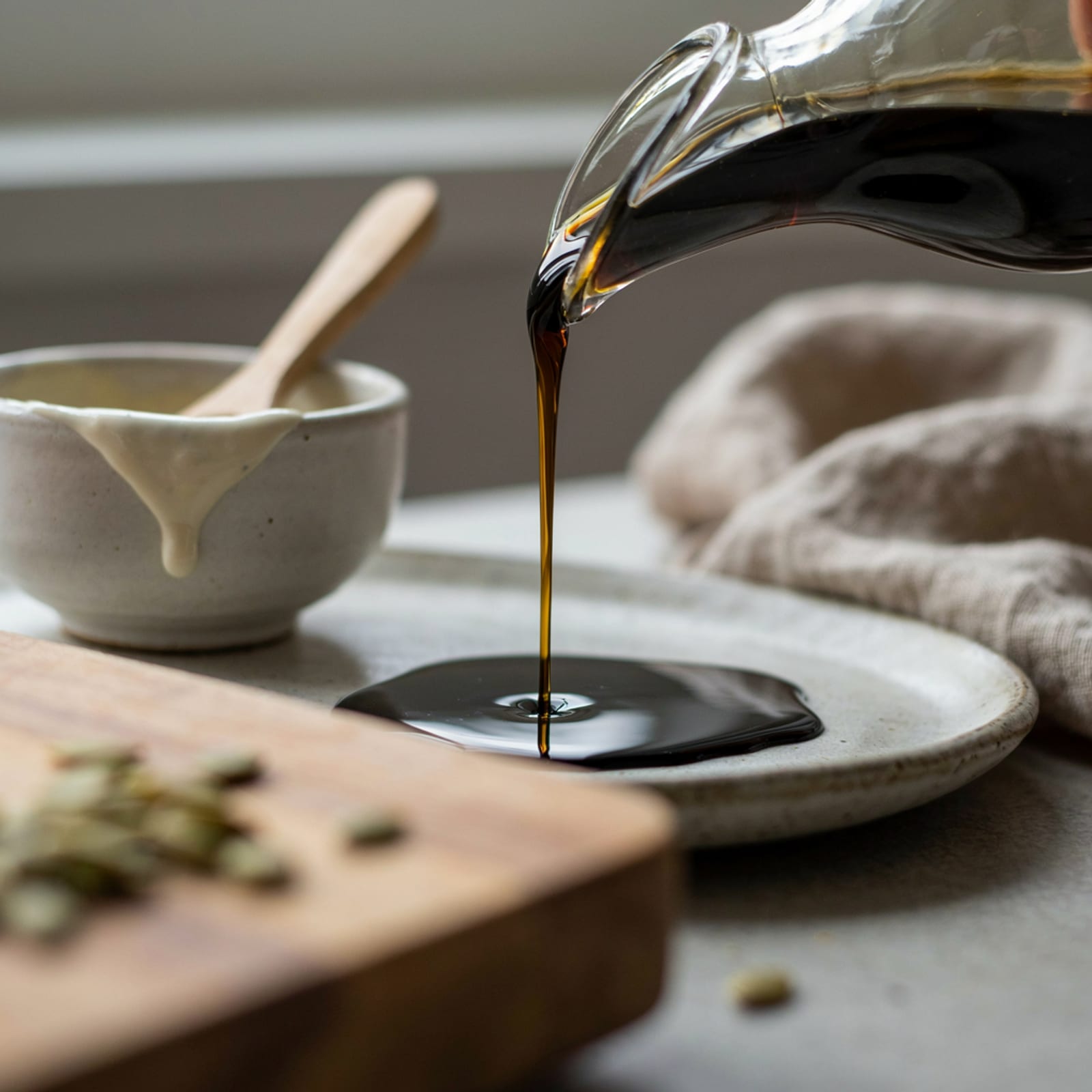
The more defensible version of a weight-related claim is about satiety and fat quality rather than direct fat loss. Fats generally slow digestion and can contribute to a feeling of fullness, and swapping a less healthy fat source for an unsaturated oil like this one — rather than adding it on top of an already sufficient diet — is a reasonable part of an overall weight-management or metabolic-health eating pattern. This is the same substitution principle discussed on the cholesterol page, applied here to weight rather than lipids specifically.
What Has Not Been Shown
No credible clinical evidence supports pumpkin seed oil as a fat burner, appetite suppressant, or metabolism booster in the way some supplement marketing implies. Any research connecting pumpkin seed to metabolic markers, such as the diabetes and liver research covered on the diabetes page and the liver page, concerns specific biochemical markers under controlled conditions — not a demonstrated real-world weight-loss effect from adding the oil to an everyday diet.
Why "Fat Burner" Marketing Persists Anyway

Oils marketed as fat burners or metabolism boosters tend to lean on the same handful of loosely connected facts — a compound with some antioxidant property, a small animal study, or a plausible-sounding mechanism — stretched well beyond what any single study actually demonstrated about real-world weight change in people. Pumpkin seed oil is not unusual in attracting this kind of framing; nearly every popular food oil has, at some point, been marketed with a weight-loss angle that outpaces its evidence, and recognising that pattern is useful well beyond this one oil.
How to Actually Use It If Weight Management Is a Goal
If weight management is a genuine goal, the practical approach is portion awareness — using pumpkin seed oil as a flavourful finishing touch in modest amounts rather than pouring it liberally, and treating it as a substitute for a less desirable fat rather than an addition alongside one. This keeps the oil's genuine culinary and nutritional value in the diet without the calorie cost undermining the goal. Sustainable weight management is built on overall calorie balance, activity, and, where needed, professional guidance — not on any single ingredient, however well-regarded. Anyone with significant weight-management goals or underlying conditions should work with a doctor or dietitian rather than relying on food-oil claims. The evidence overview puts this topic in perspective alongside the rest of the oil's researched effects.
Shop premium Styrian pumpkin seed oil
Shop now