The Styrian
Pumpkin Seed Oil Journal
The Styrian
Pumpkin Seed Oil Journal
- The Styrian Pumpkin Seed Oil Journal
Shop EN
pumpkinseedoil.ccShop DE
kuerbiskernoel.cc
About
This website also contains some content created with the support of AI.
Pumpkin Seed Oil in Other Languages
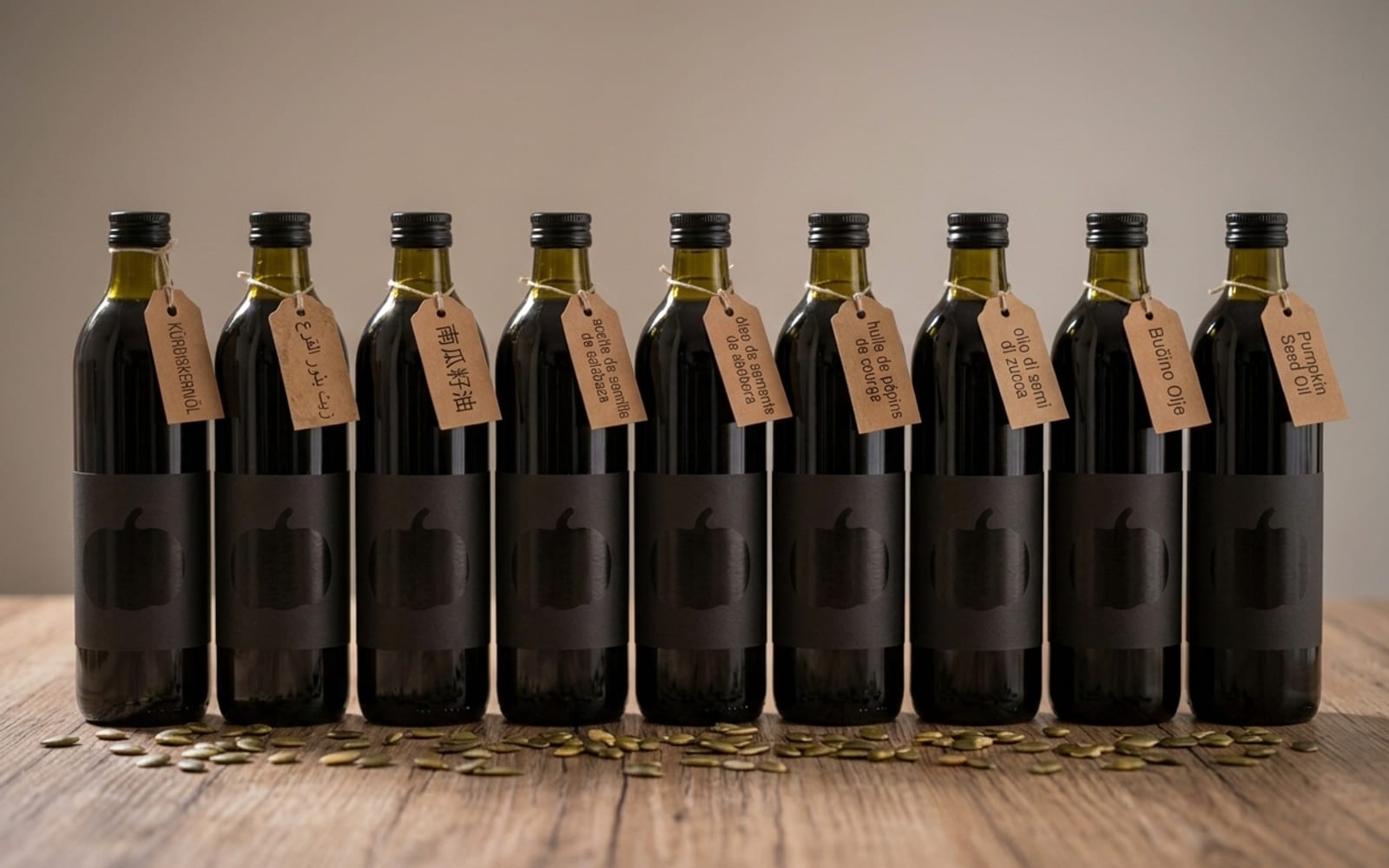
Picture standing in a small delicatessen far from Styria — maybe in Ljubljana, maybe scrolling an overseas online shop. The word on the label doesn't register right away. Open the bottle anyway, and the same warm, nutty smell rises that you already know from home. On its way across Europe and beyond, Styrian pumpkin seed oil has picked up many names — some translated word for word, some shaped slightly by the language it landed in. Knowing those names keeps the original in view no matter where the bottle turns up.
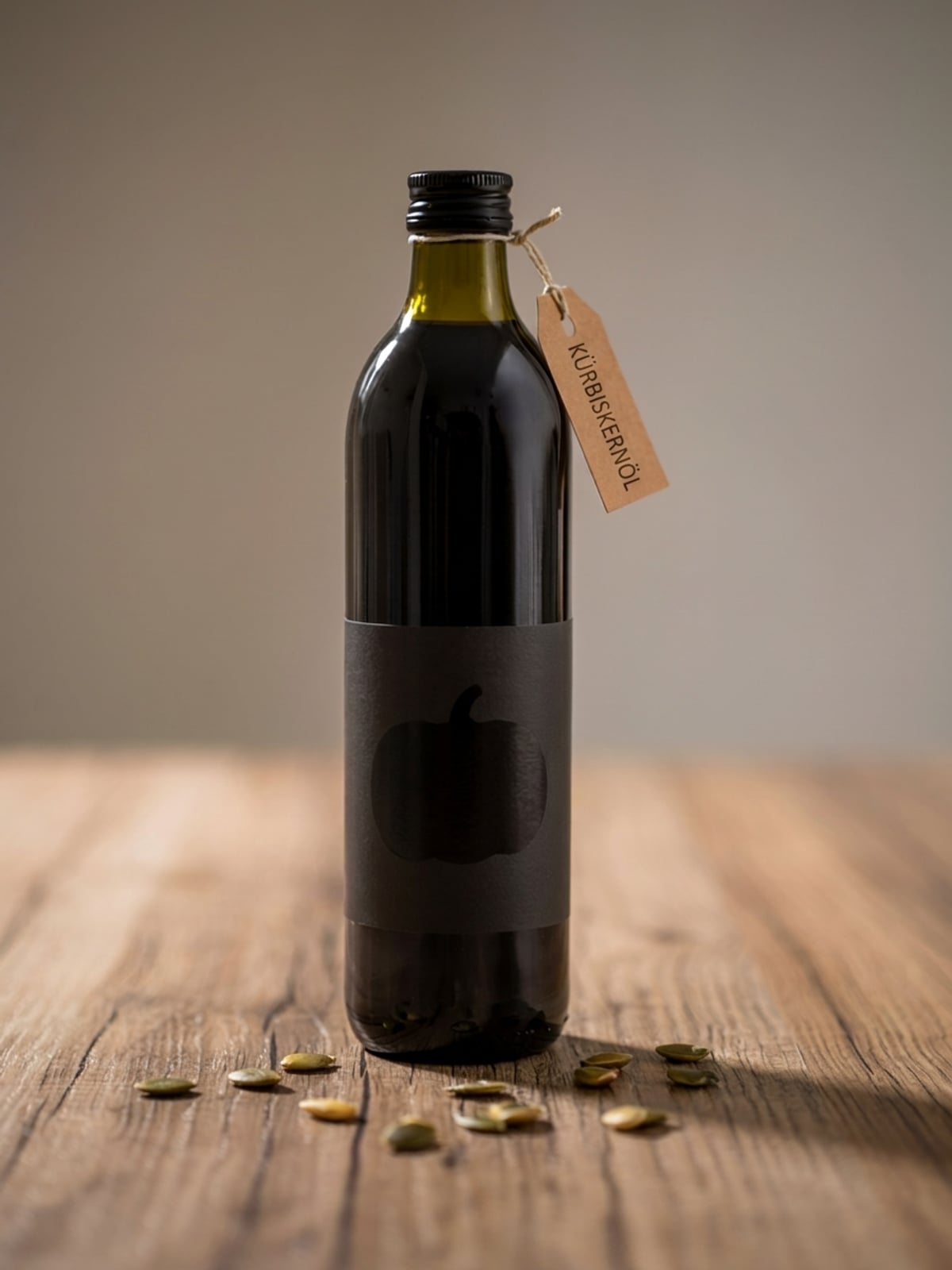
The German original: Kürbiskernöl
The starting point is a simple compound word: Kürbiskernöl, built from pumpkin, seed and oil. In Austria and southern Germany you also meet Steirisches Kürbiskernöl — the exact name behind the PGI seal. The abbreviation PGI stands for "protected geographical indication," the EU-wide origin mark. What that seal actually guarantees is explained under Styrian PGI explained. Once you know those three word parts, the label reads clearly even without any German — an Austrian return address on the back is a further clue, though the PGI seal remains the most reliable confirmation.
Slovenian: bučino olje
Just across the next border, the name already changes. In neighbouring Slovenia, which shares the same pumpkin-growing tradition on the wide Styrian plateau, the oil is called bučino olje — from buča (pumpkin) and olje (oil). Slovenian producers hold their own EU PGI status, and genuine Slovenian bučino olje comes from the same hull-less seeds, roasted and pressed the same way. At Slovenian farmers' markets and small shops along the Austrian border, that is exactly the name worth looking for.
Italian: olio di semi di zucca
Travel further south and the word takes on a different shape: olio di semi di zucca, literally "oil from pumpkin seeds." Italy is one of the most important export markets for Styrian pumpkin seed oil — in Friuli and the regions closest to Austria, the dark bottle has long sat on restaurant tables. Italian packaging sometimes carries the origin mark as IGP (Indicazione Geografica Protetta), the Italian equivalent of the European seal — the same guarantee, just under a different abbreviation.
French: huile de pépins de courge
In French it becomes huile de pépins de courge — again "oil from pumpkin seeds," just arranged differently. France has a strong food culture and a lively market for specialty oils, which is why Styrian pumpkin seed oil turns up in upscale grocers and delicatessens. Here too, the label carries the IGP abbreviation.
Spanish and Portuguese
On the Iberian Peninsula, two languages share almost identical logic: Spanish calls the oil aceite de semilla de calabaza, Portuguese óleo de semente de abóbora — both literally "pumpkin seed oil." These names appear in specialty shops across Spain and Portugal, and increasingly in Latin American markets, where interest in artisanal European oils has grown in recent years. The challenge there: generic pumpkin seed oil from other pumpkin varieties, cold-pressed without roasting, often carries the same name. The PGI logo remains the most reliable filter.
Mandarin: 南瓜籽油
At the far end of the journey, the Latin alphabet gives way entirely to a different script: 南瓜籽油 (nán guā zǐ yóu), literally "southern pumpkin seed oil" — 南瓜 is the standard word for pumpkin, 籽油 for seed oil. Since Styrian pumpkin seed oil reached the Chinese specialty market, this is the spelling you find on import packaging and online listings. PGI status isn't always highlighted prominently in Chinese retail — one more reason to buy from established importers who disclose their sourcing.
Arabic: زيت بذور القرع
In Arabic, pumpkin seed oil is most often written زيت بذور القرع (zayt budhūr al-qar'), which likewise means "pumpkin seed oil." In Arabic-speaking markets, interest tends to centre on its nutrient profile and kitchen versatility; the product typically appears in health-food and specialty stores. As in other import markets, the PGI seal on the packaging together with a declared Styrian or Slovenian origin remains the most reliable sign of the traditional product.
Why the name on the label matters
This knowledge is useful for more than curiosity. Anyone travelling in Europe or shopping on international platforms recognises, thanks to the local name, what the matching origin mark should look like. An Italian label reading IGP next to olio di semi di zucca from a Styrian or Slovenian producer describes the same product sold as PGI in Austria. The reverse is also true: a product carrying one of these names with no origin mark at all can come from a completely different growing region — and differ noticeably in taste, colour and character from the roasted Styrian original.
The glossary runs through the key terms and origin marks in one place, and what is Styrian pumpkin seed oil gives the full introduction. The story of how this oil earned its reputation across markets and language borders is told under why it's called green gold — whatever the bottle is called in your language once it finally sits on your own table.
Buy Styrian pumpkin seed oil worth tasting
Shop now