The Styrian
Pumpkin Seed Oil Journal
The Styrian
Pumpkin Seed Oil Journal
- The Styrian Pumpkin Seed Oil Journal
Shop EN
pumpkinseedoil.ccShop DE
kuerbiskernoel.cc
About
This website also contains some content created with the support of AI.
Harvesting the Styrian Oil Pumpkin
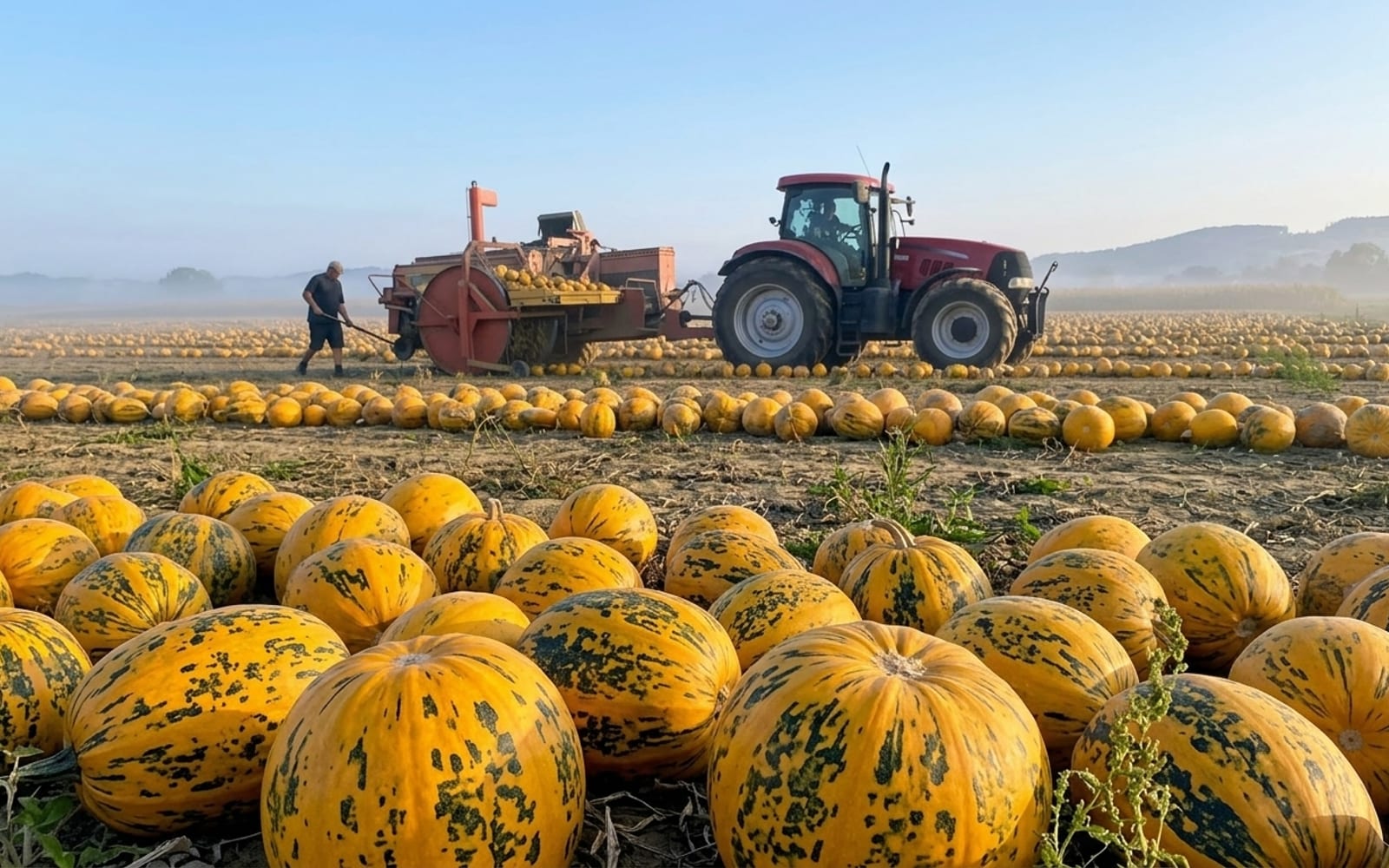
Before the sun has burned off the morning mist, something heavy hangs over the fields. Damp soil, wilting leaves, and beneath it something faintly sweet that doesn't register at first — until you place it: split-open pumpkins. October in Styria. And these few weeks decide everything that ends up in the bottle later. More on the plant behind the harvest lives under the Styrian oil pumpkin.
The harvest window opens in autumn
The Styrian oil pumpkin is harvested in September and October. There's no fixed date on the calendar for it — anyone looking for one quickly learns the plant runs on its own rhythm instead. First the leaves turn yellow, then the vines wilt. Once the shell has hardened so much that a fingernail no longer sinks in, the plant has stopped growing. Everything it still had to give is now stored in the seeds.
The window shifts from year to year. A wet, cool summer slows growth and pushes the harvest later. A warm, dry summer speeds everything up — the seeds ripen earlier, sometimes with more concentrated aroma. Anyone harvesting well reads the pumpkin, not the calendar.
The narrow window between too early and too late
This is exactly where the real challenge of the harvest sits. Fruit cut too early gives up seeds that still carry too much moisture and press poorly. Harvested too late, rain, frost, or rot can put an entire vintage at risk. Anyone who's lived with this rhythm for years knows the tension well. You'll often hear it said plainly: the vine doesn't lie. It wilts reliably once the time is right — regardless of whatever the weather happens to be doing.
Hit that window, and you can breathe easy. Hesitate, and you feel it in the oil later.
Inside the pumpkin — the green everything builds toward
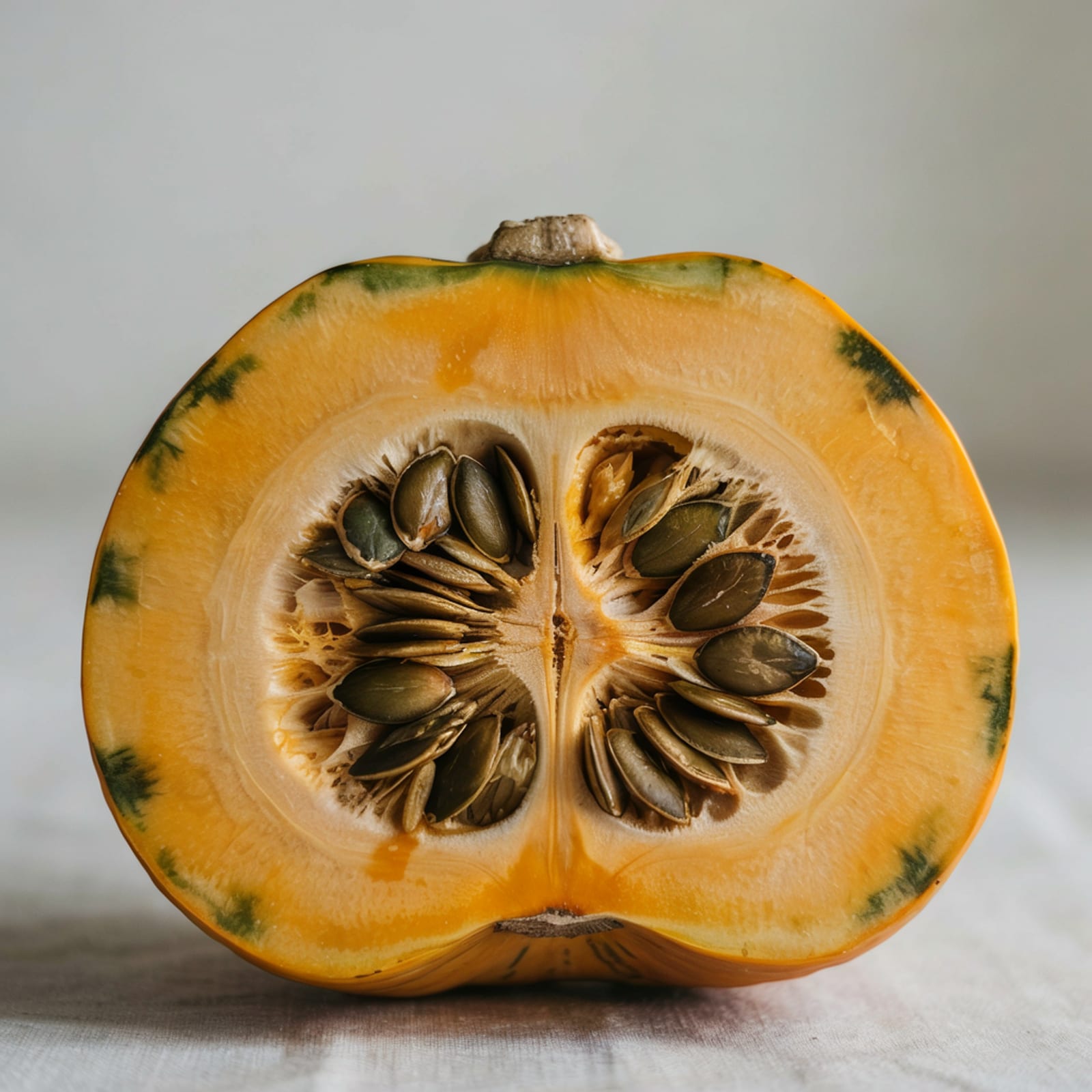
When a fruit is split open, what the whole summer worked toward finally shows itself. The knife parts the hard shell, the orange flesh opens up — and inside sit the seeds: grey-green, packed tightly together, embedded in damp fibrous strands. The smell is fresh, nutty, and faintly grassy at once. Seeds that are full and evenly green promise an oil with depth. Seeds that look blotchy or too pale can point to a difficult summer.
At this moment, the link to the finished oil still feels distant — but it's already visible. The green looking out from the flesh here will turn up again in every bottle at the end.
Machine or blade — how the seeds get exposed
On smaller farms, fruit is still split open by hand — blade, hand labour, cool autumn air. Slow work, but attentive to each individual fruit. On larger operations, a specially adapted combine harvester now does the job instead. It rolls across the field, separates seeds from shell in a single pass, and lays the green seeds ready for the next step immediately. What's left behind is the shell. It returns to the soil, breaks down over winter, and readies the field for the following year.
Blade or machine — either way, the same green seeds end up in the same containers, ready for washing.
Washing — and the first read on the vintage
Freshly separated seeds still carry traces of flesh and fruit juice. They're washed to remove those residues before they dry on and leave off-flavours behind. It sounds like a routine step — and it matters all the same. Anyone who picks up a handful of washed seeds and smells them gets an early, honest read on the vintage: aromatic and intense, or more reserved.
Then the long wait begins.
Drying — where time itself becomes a craft
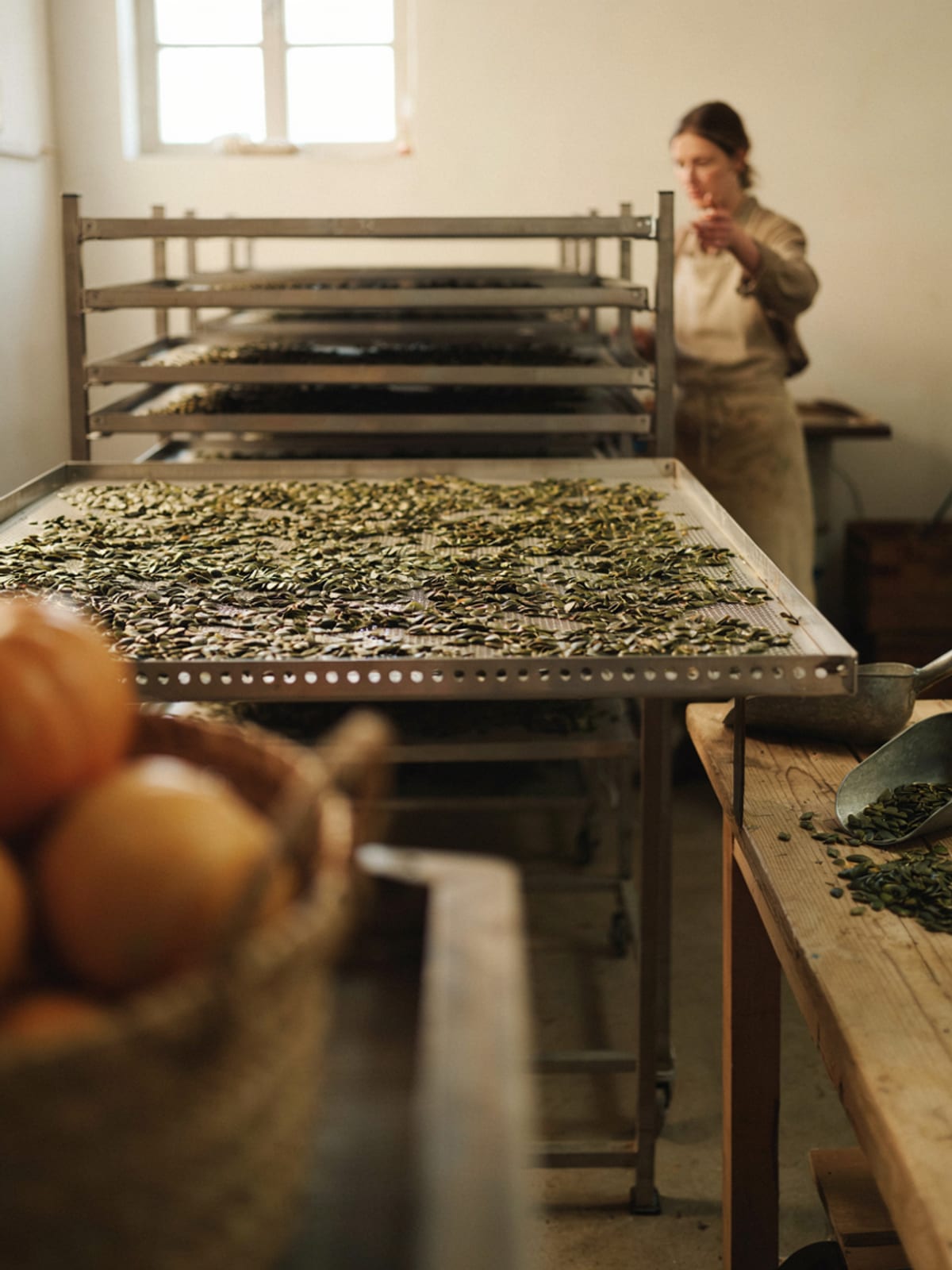
The washed seeds are spread across flat racks — loose enough for air to circulate evenly. No direct heat source, no shortcuts. Anyone checking the seeds turns them by hand now and then, smells them, feels their texture — whether they're still too soft, whether they're drying evenly, whether the surface feels firm. It's quiet work, and you can't speed it up without losing something in return.
Seeds that retain too much moisture won't press cleanly later and tend toward mould in storage. Seeds dried too fast or too hot lose their aromatic compounds before they ever reach the mill. Finding the right balance — even air circulation, moderate temperature, enough time — is a skill built up over many harvests. You'll often hear it said: the seed that dries slowly gives the best oil later.
From the barn to the mill
Once the seeds are properly dried, they're stored under controlled conditions until pressing. How long that takes varies from farm to farm. Some press the fresh harvest within a few weeks to capture the aroma at its peak. Others spread processing evenly across the winter so the mill can supply fresh oil year-round. Both paths can produce excellent oil — what matters is that storage stays cool, dry, and protected from pests.
When the seeds finally enter the mill, the circle closes: the green of the autumn fields becomes a deep, dark oil.
A season that brings Styria together
The harvest is more than an agricultural event in Styria. Pumpkin festivals, farm open days, and mill visits draw families and guests from across the region every autumn. What was once heavy fieldwork has become, over generations, a piece of regional identity. The story behind it reaches back a long way and is traced in full under the history of Styrian pumpkin seed oil. Exactly where these fields sit — on the volcanic hills of southern Styria, in the gentle valleys toward Burgenland — is described under origin: Austria and Styria.
Anyone holding a bottle of pumpkin seed oil sees none of this. But what's inside was decided in those few autumn weeks — on a field, in cool morning air, by green seeds that had already given their best at that exact moment.
Order authentic Styrian culinary oil
Shop now