The Styrian
Pumpkin Seed Oil Journal
The Styrian
Pumpkin Seed Oil Journal
- The Styrian Pumpkin Seed Oil Journal
Shop EN
pumpkinseedoil.ccShop DE
kuerbiskernoel.cc
About
This website also contains some content created with the support of AI.
Zinc in Pumpkin Seeds and Oil
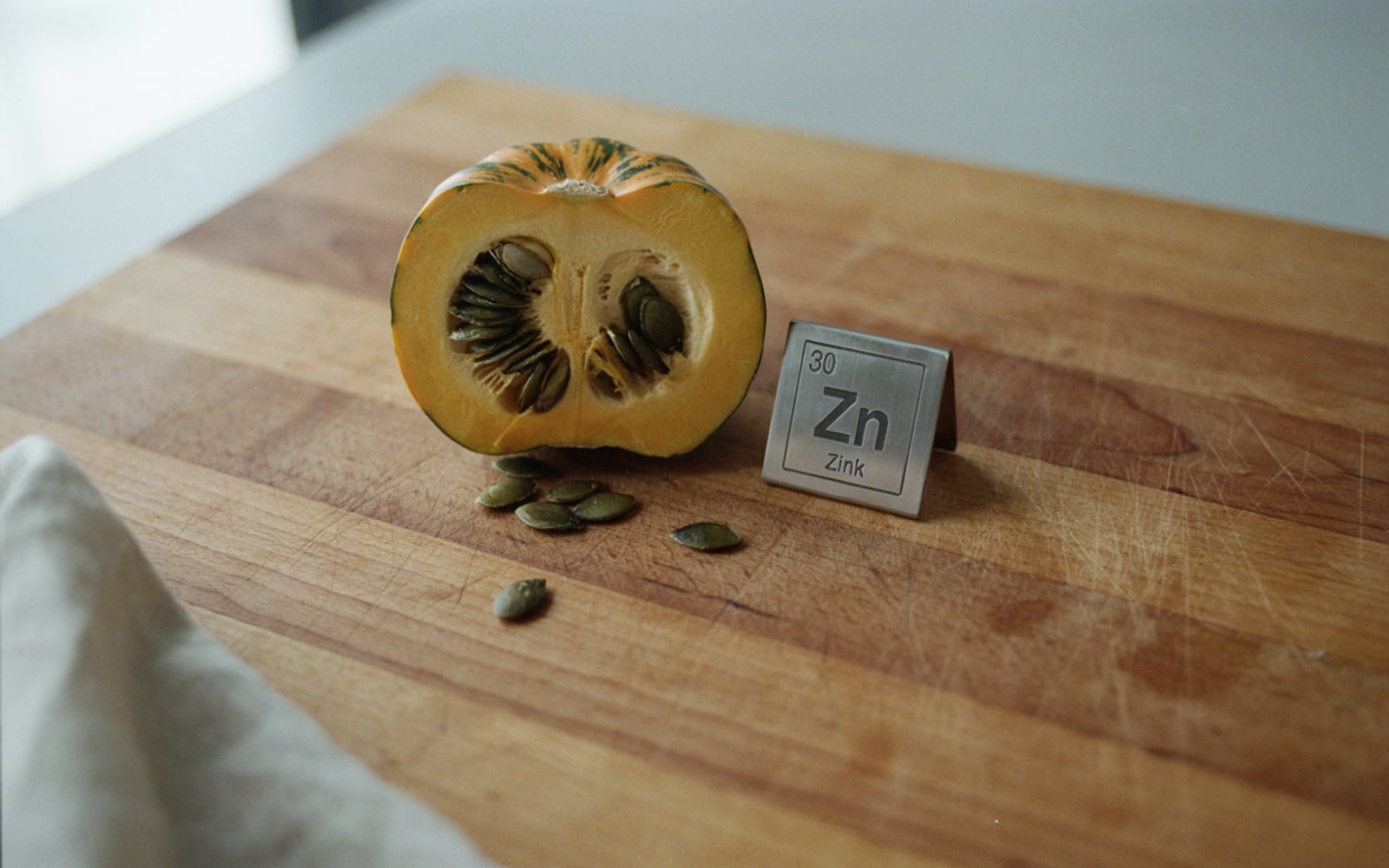
"Pumpkin seeds are rich in zinc" is a sentence you hear often, and it is true. What is less often true is the assumption many people attach to it: that pumpkin seed oil must carry the same zinc load. Between seed and oil, though, sits one working step that prevents exactly that — the press. Understanding what actually happens there sets realistic expectations for both products.
A Mineral That Doesn't Travel
Zinc is a mineral, and like all minerals it is water-soluble — bound to proteins, enzymes, and the structural components of the seed's tissue. It is not fat-soluble. That single fact decides its fate at the press: when pumpkin seeds are pressed, the process separates the lipid phase, the oil, from the solid phase, the press cake. Zinc stays almost entirely in the press cake, because it has no affinity for fat. The press cake keeps the protein matrix, the fibre, and the water-soluble minerals; the oil takes with it only the fat, the fat-soluble vitamins, the phytosterols, and the characteristic colour pigments.
What Lab Analyses Actually Show
Independent analyses of cold-pressed pumpkin seed oil consistently find only trace amounts of zinc in the oil itself — far below what sits in the whole seed. By no reasonable measure is a tablespoon of oil a meaningful zinc source. Some labels still hint at a zinc connection, because the seed is known for it. That association applies to the seed, though, not to the pressed oil — a label making an explicit zinc claim for an oil deserves a second, sceptical look, unless there is an actual analytical value behind it. The full nutrition picture of the oil appears in nutrition facts.
A Handful That Proves It
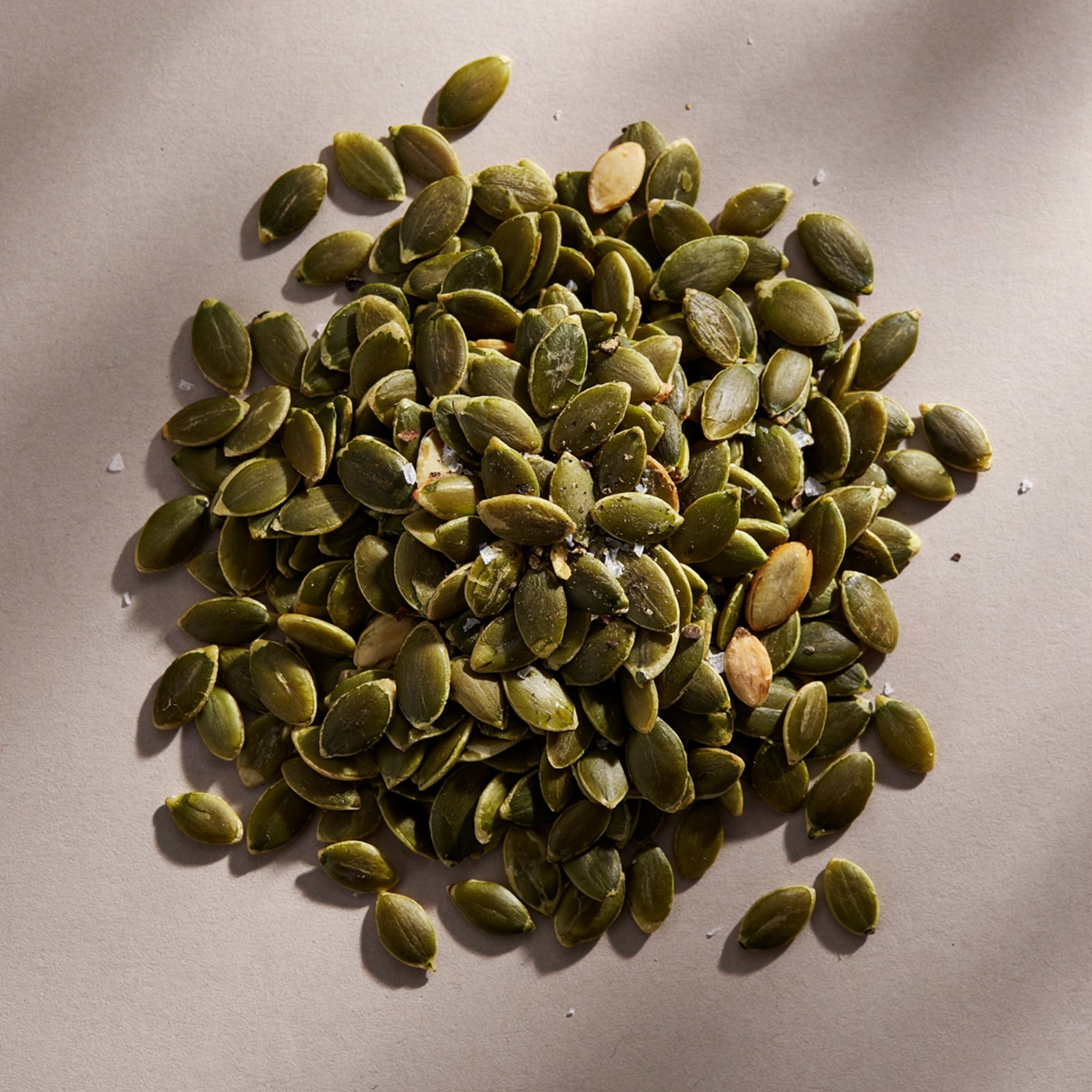
The proof sits literally in the hand: a handful of shelled, dark green seeds, their surface faintly oily, their weight surprisingly dense for such small pieces. Eaten roasted and lightly salted as a snack, or worked into a spread, they supply 2 to 4 milligrams of zinc per 30-gram serving — a meaningful share of the recommended daily intake for adults of roughly 8 to 11 milligrams, depending on age and sex. That holds for roasted seeds just as much as raw ones. Anyone interested in zinc from pumpkin products is better off reaching for the seed itself — instead of the oil, or alongside it. The comparison across several nutrient dimensions is covered in seeds or oil.
Why the Mix-Up Happens
Part of the reason zinc so often gets mentioned in the same breath as pumpkin seed oil lies in how closely the two products are linked in the kitchen and in folk medicine. In German-speaking regions, pumpkin seeds and pumpkin seed oil have been used together for centuries, and mentions of one product's nutrients slide easily into conversations about the other. As everyday shorthand, that is understandable. From a nutrition science standpoint, it becomes inaccurate the moment it is applied to the oil — a point worth keeping in mind whenever a health claim shows up around either of the two products.
At the Table, Where Both Meet
And that is exactly where the mix-up usually becomes concrete: at the table, when both products show up together. A drizzle of oil over the leaves, a few roasted seeds scattered on top — the same meal, two completely different nutrient profiles in one bowl. Anyone thinking only of the flavour treats "pumpkin seed" as one thing. Anyone who knows the chemistry knows better: what gives the oil its aroma has nothing to do with what gives the seed its zinc — the two complement each other on the plate without ever chemically mixing.
What the Oil Actually Brings
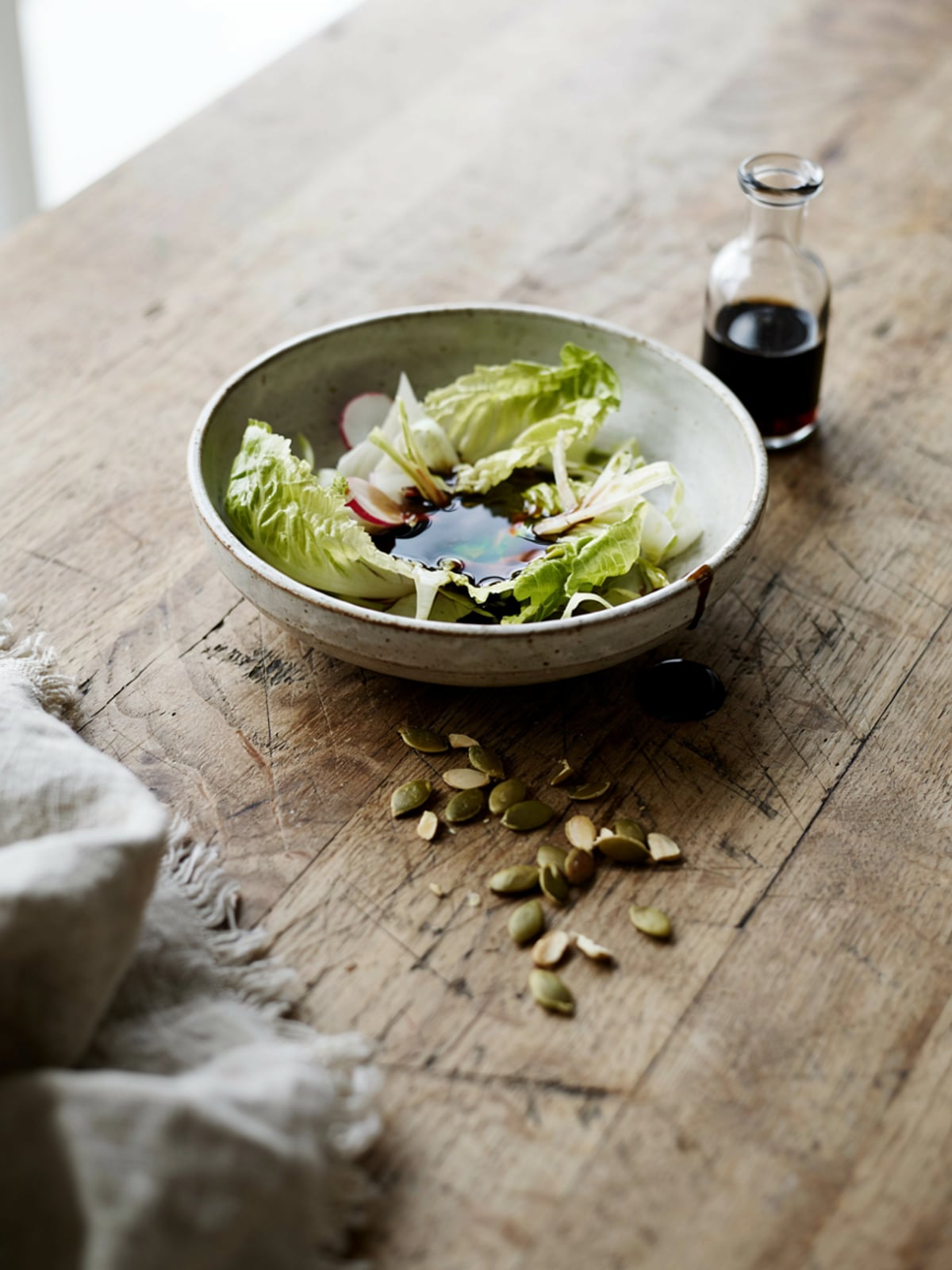
Even though zinc is not part of the oil, pumpkin seed oil brings other micronutrients genuinely its own, ones the press cake does not offer. Vitamin E, mostly as gamma-tocopherol, phytosterols such as beta-sitosterol and the characteristic delta-7 sterols, and the carotenoid pigments all concentrate in the oil phase during pressing. These micronutrients deserve to be judged on their own footing — not as a stand-in for the seed's mineral content. Vitamins and minerals goes into this in more depth.
A Realistic Picture
Pumpkin seed oil is nutritionally valuable as a predominantly unsaturated fat with a characteristic phytosterol and vitamin E content — in an intensely aromatic form that invites measured, deliberate use. It is not a mineral supplement, and zinc is no reason to choose it over another oil. Anyone wanting to take in zinc does so far more effectively with the seeds — roasted and eaten as they are, or added to dishes. The oil earns its place at the table through flavour, its fatty acid pattern, and culinary character, not through a mineral content it never had and never claimed.
Nutrition notice: Nutrient figures are indicative and depend on product and portion. They are not health claims under EU Regulation 1924/2006.
Buy Styrian pumpkin seed oil for cooking
Shop now